


Full dictionary entries Premium
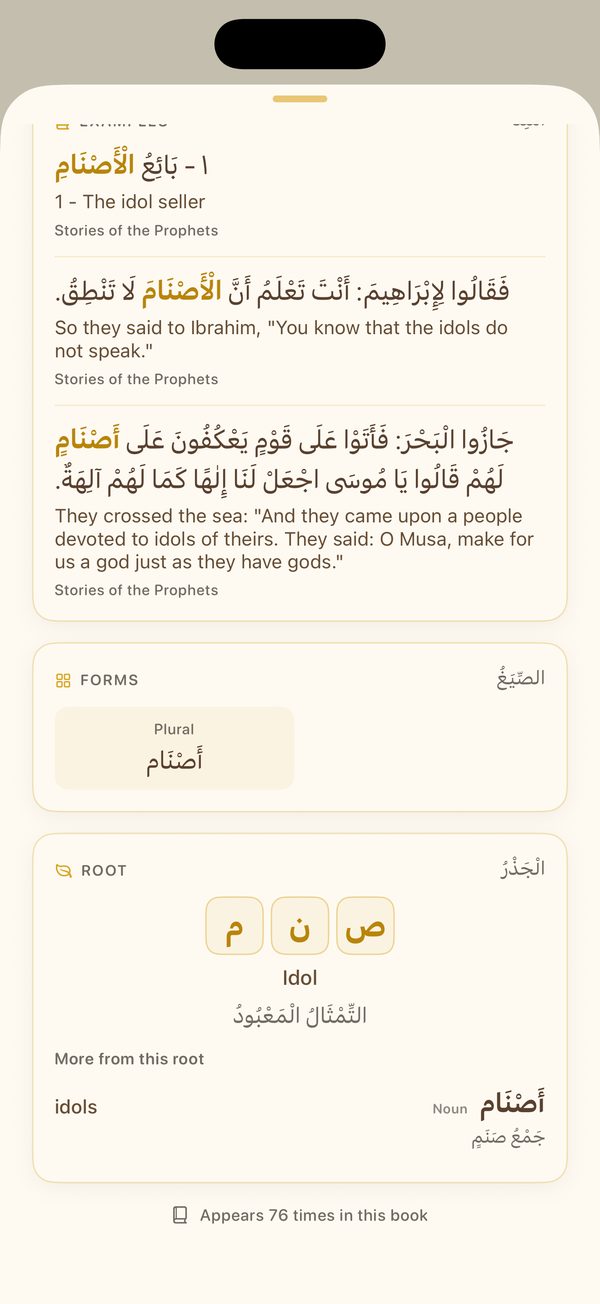
See a word’s parts, its root and the words that share it, every meaning with an Arabic explanation and an example from the books, and its plural, present tense and other forms.
أَهْلًا وَسَهْلًا
Know your Arabic letters? You’re ready for these books.
Classical works by real scholars, from the Stories of the Prophets to Ibn al-Jawzi, with every word one tap from its meaning, root and grammar.
Free to download · iPhone and iPad with iOS 17 or later · Android 7.0 or later
Can you sound this out?
وَكَانَ آزَرُ يَبِيعُ الْأَصْنَامَ.
Then Maktabati is for you.
It means “Azar used to sell idols.” From Qaṣaṣ an-Nabiyyīn, Stories of the Prophets.
New to the letters? Learn them first with a free Qaida, then come back. We’ll be here.
Try it here
Tap a word, just like in the app.
“Then Ibrahim became angry and took the axe.” From Qaṣaṣ an-Nabiyyīn, Stories of the Prophets.
Made for readers who know the letters
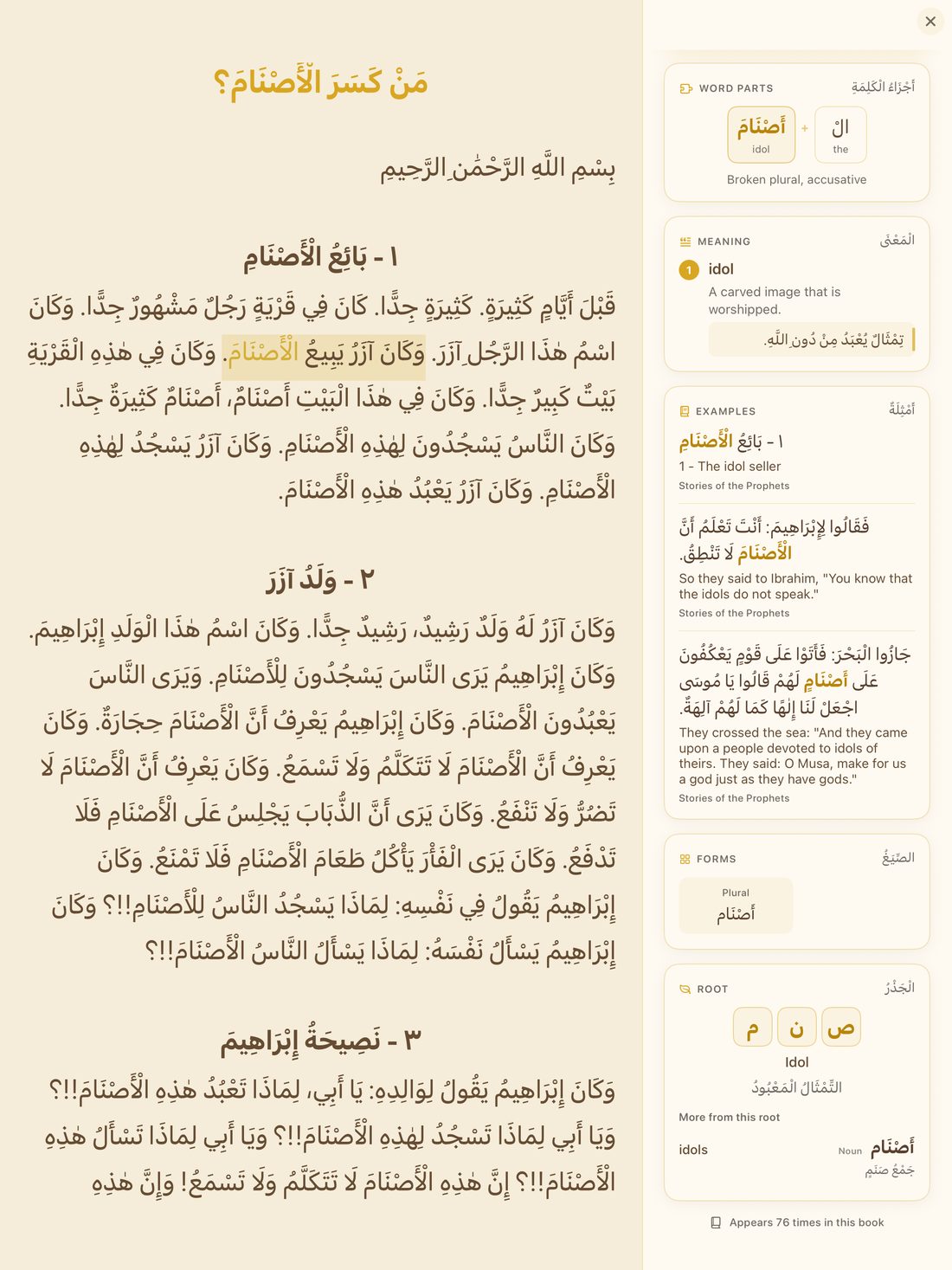
Tap it. Its meaning in that sentence, its root and its grammar open right there.
Earn your apps back by reading. Every minute you read adds a minute.
Daily flashcards from the books you read, each tied to its root.
They’re here, with more arriving in the online library.
How it works
Begin with Stories of the Prophets, written for beginners, or take any book from the shelf.
See what it means in that sentence, hear it spoken, and open its full dictionary entry.
Save it as a flashcard, then lock it in with quick quizzes and word games.
Everything in one place
Maktabati is built around one idea: you learn Arabic best by reading real Arabic, with help exactly when you need it.
See a word’s parts, its root and the words that share it, every meaning with an Arabic explanation and an example from the books, and its plural, present tense and other forms.
Every word in the book has a translation that fits the sentence it is in, and the beginner books add a transliteration.
In the beginner books, play any word as you read, so you learn how it sounds as well as what it means.
Save a word with one tap. Sort your words into your own decks and tidy them in bulk.
Test yourself on the words you saved, track your accuracy and watch your vocabulary grow.
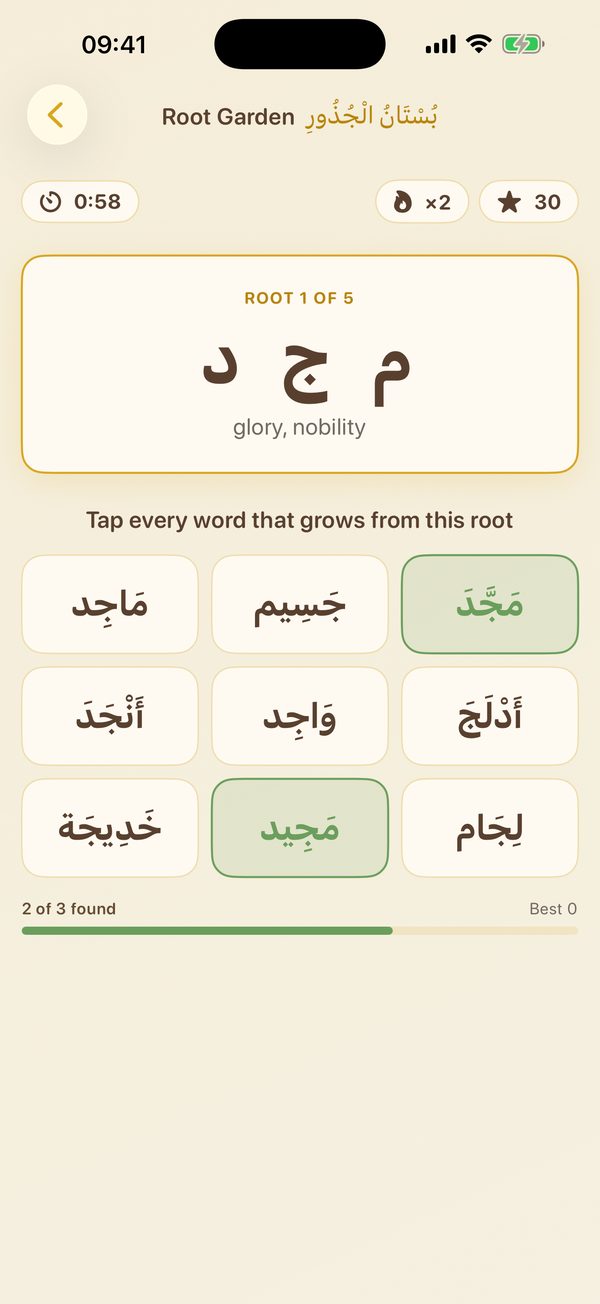
Find every word that grows from a root in Root Garden, and put a sentence from the book back together in Sentence Builder.
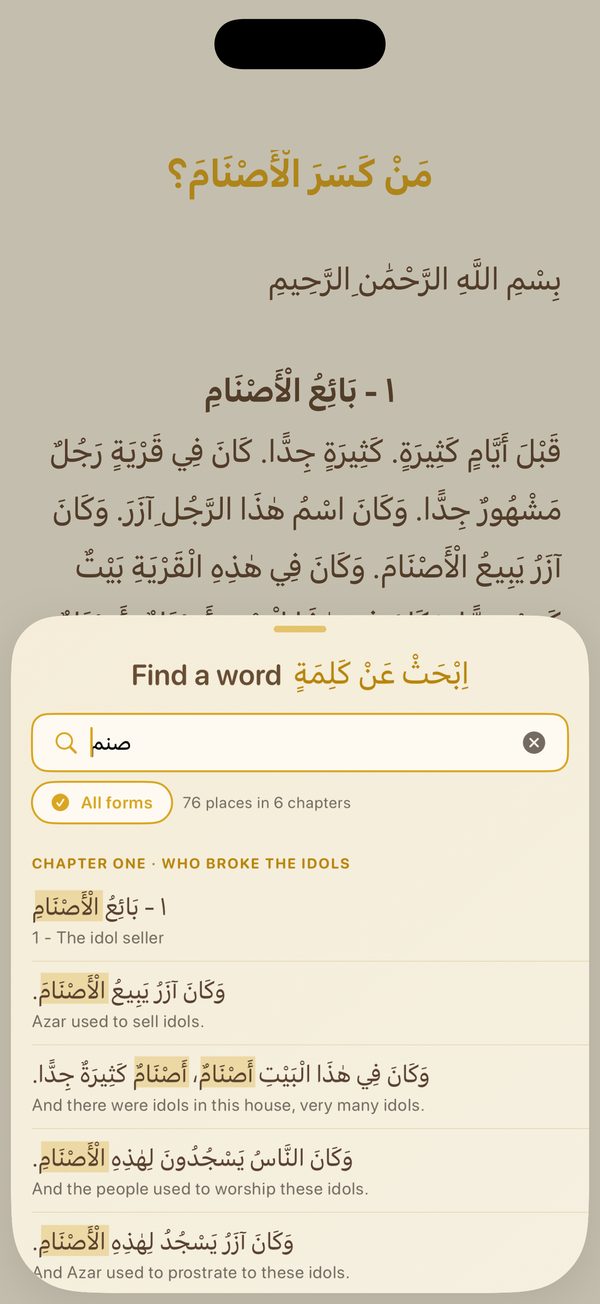
Search a book for an Arabic word, with or without vowels and in all its forms, or for an English word in the translation, and jump to each place it appears.
The reader
Read the original text with full vowel marks, page by page, right to left. Maktabati remembers where you stopped, so every session starts on the right page.
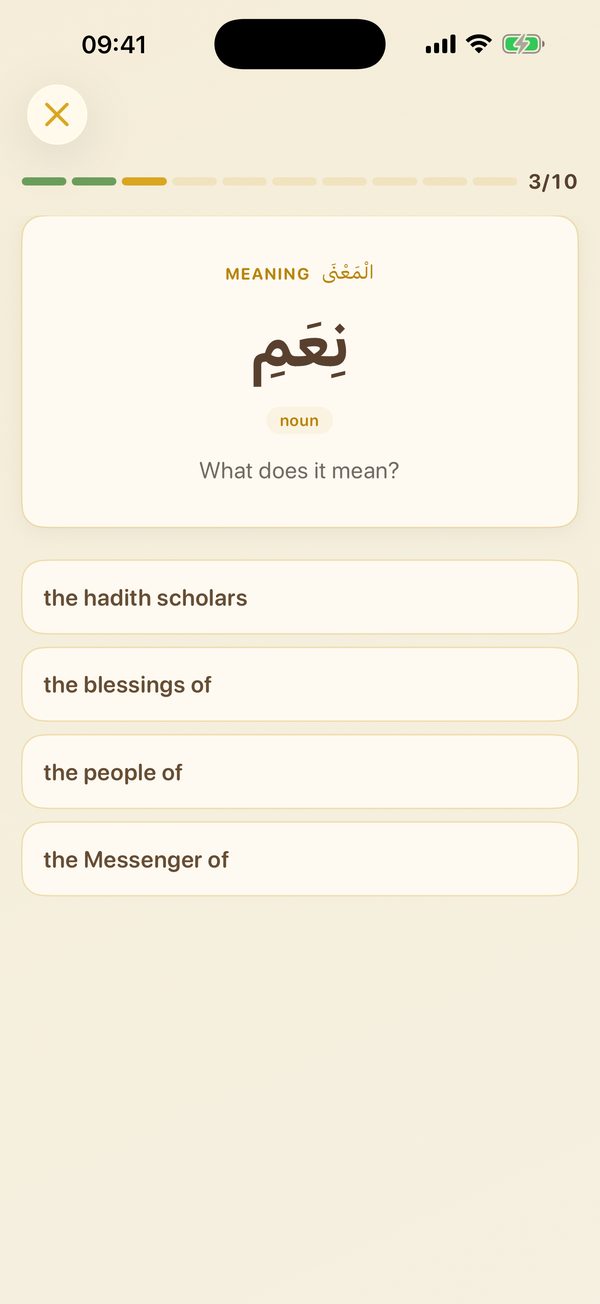
Flashcards and quizzes
The words you save while reading become your flashcards. A few minutes of quizzing a day turns them into vocabulary you actually remember.
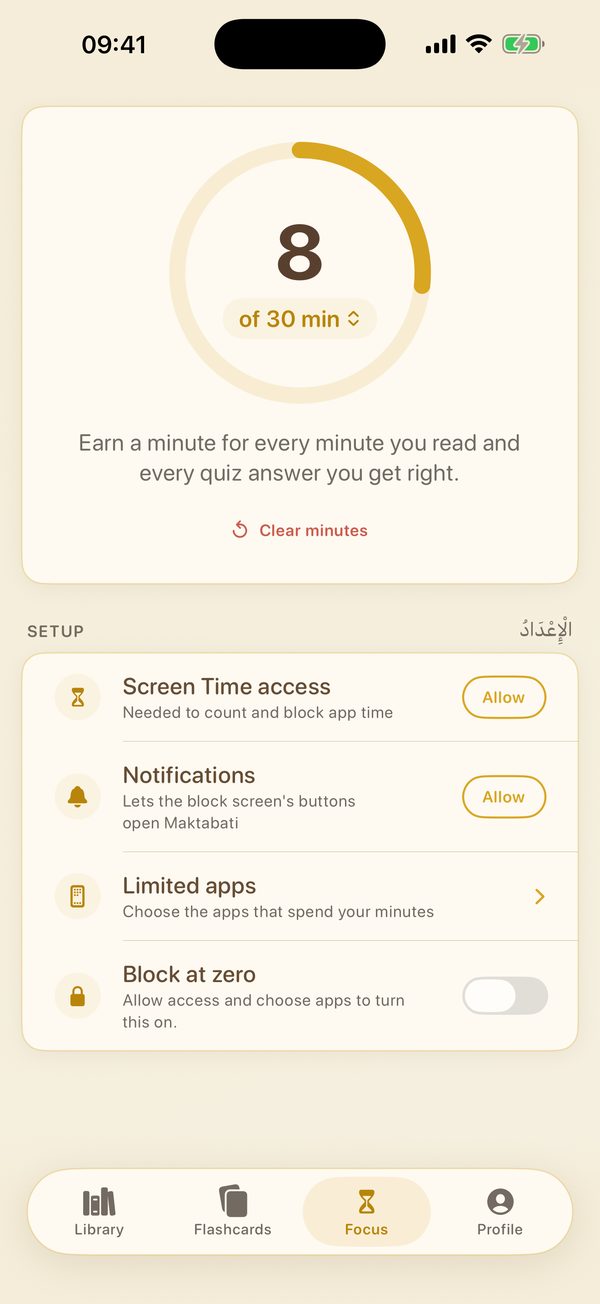
Focus
Pick the apps you want to use less. Maktabati keeps them locked until you have earned the minutes, one minute of reading at a time. It uses Apple’s Screen Time on iPhone and the Accessibility service on Android.
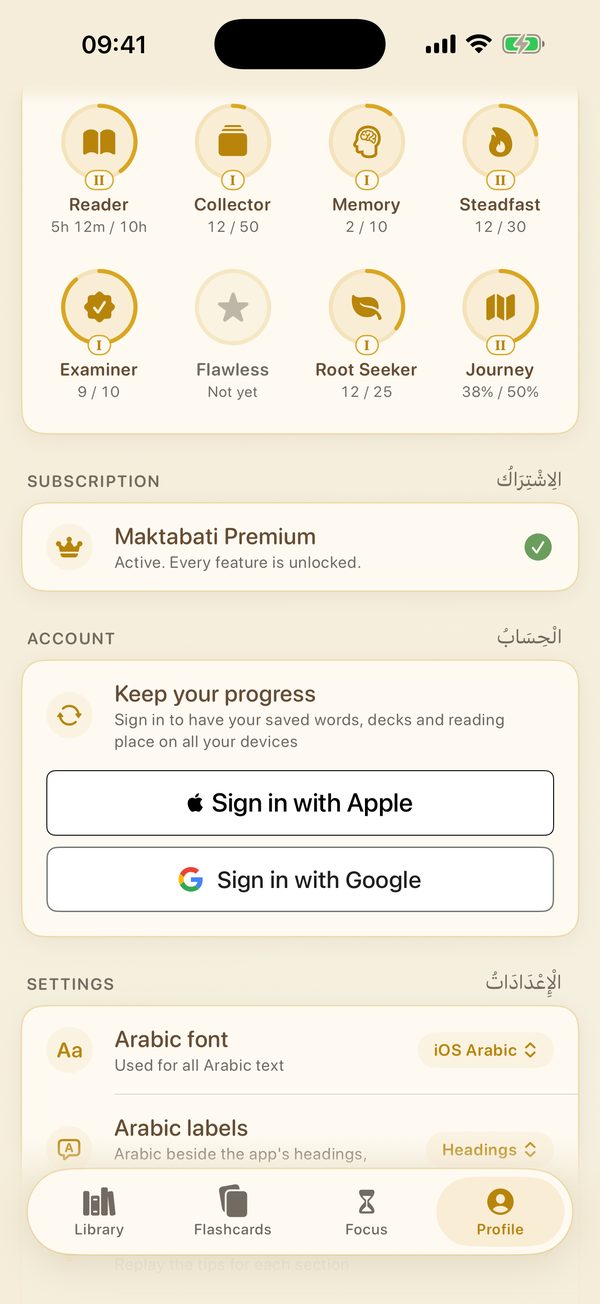
On all your devices
Read on iPhone, iPad and Android. Sign in if you like, with Apple or Google on iPhone and iPad or with Google on Android, and your saved words, decks and reading place follow you from one device to the next.
The library مَكْتَبَتِي
Start with books written for beginners, with every word vowelled and spoken, then move on to moderate texts as your Arabic grows.
Qaṣaṣ an-Nabiyyīn · Shaykh Abul Hasan Ali Nadwi
Written to teach Arabic to children and beginners through the lives of the Prophets, in simple, fully vowelled prose.
Al-Arbaʿūn an-Nawawiyyah · Imam Yahya ibn Sharaf an-Nawawi
Forty-two hadith of the Prophet ﷺ, each one a foundation of the religion. Short, well known and easy to learn by heart.
Al-Arbaʿūn al-Qudsiyyah · From the hadith collections
Forty hadith in which the Prophet ﷺ tells what his Lord said, about mercy and forgiveness, prayer and fasting, Paradise and the Fire.
Min Akhlāq ar-Rasūl al-Karīm · Shaykh ʿAbd al-Muhsin al-ʿAbbad
A lecture given at the Islamic University of Madinah on the Prophet’s ﷺ generosity, humility, mercy, forbearance and courage.
Laftat al-Kabid · Imam Ibn al-Jawzi
The letter Ibn al-Jawzi wrote to his son when he saw him slacking in his studies: work hard, use your time, and seek knowledge as I did.
Ad-Dāʾ wa ad-Dawāʾ · Imam Ibn Qayyim al-Jawziyyah
Ibn al-Qayyim’s answer to a man struck by an affliction he could not cure: on supplication and hope, and what sins do to the heart, the body and this world and the next.
Our mission
Maktabati puts the classical books of Islam at your fingertips: books of immense benefit that are expensive and hard to find in print in the West. With a complete Arabic dictionary under every word, daily flashcards that tie each word to its root so the vocabulary becomes part of how you think, and a focus mode that trades doomscrolling for reading, anyone who can read the Arabic letters can nourish their soul with the words of the scholars themselves.
All you need is to read the Arabic letters, even slowly. Maktabati opens on Stories of the Prophets, which was written for beginners. In the beginner books every word has a translation and transliteration, and you can hear it spoken.
New to the letters? Learn them first with a free Qaida, then come back. We’ll be here.
No. Everything works without one, and your words and progress are kept on your device. If you like, sign in from Profile (with Apple or Google on iPhone and iPad, with Google on Android) and your saved words, decks and reading place stay in step on all your devices. Premium belongs to your App Store or Google Play purchase, not to this account.
Subscriptions are handled by Apple or Google. On iPhone, open Settings, tap your name, then Subscriptions, and choose Maktabati. On Android, open the Play Store, tap your profile picture, then Payments & subscriptions and Subscriptions, and choose Maktabati.
Cancel at least 24 hours before the renewal date and you won’t be charged again.
On iPhone, sign in with the same Apple Account and open Maktabati. Open the Premium screen, for example from Upgrade to Premium in Profile, and tap Restore at the top.
On Android, use the same Google Account in the Play Store, then tap Restore Purchases in Profile.
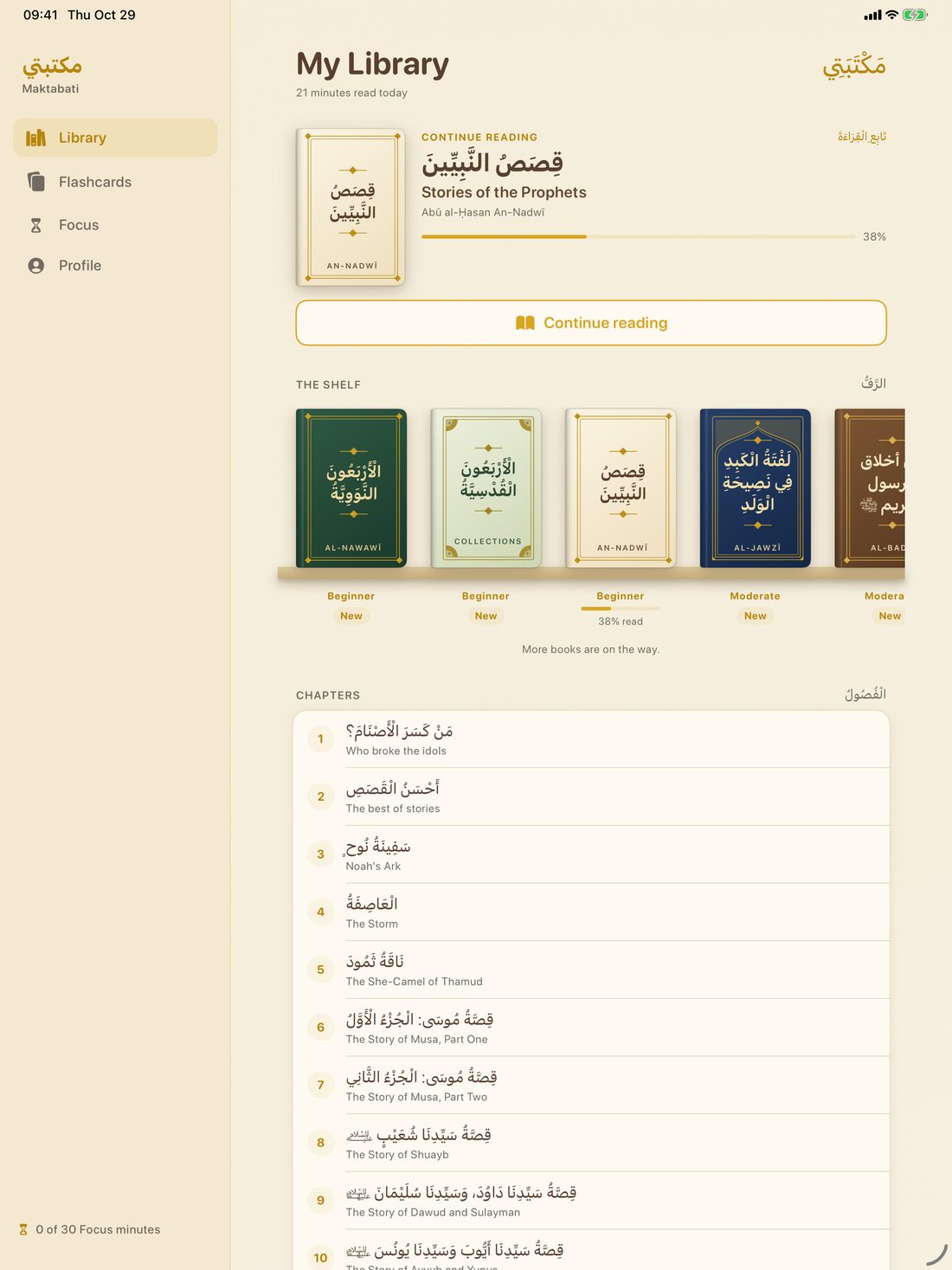
Yes. Maktabati is on the App Store for iPhone and iPad with iOS 17 or later, and on Google Play for Android phones and tablets with Android 7.0 or later. On iPad and tablets the Library shows the chapters beside the shelf.
Only now and then. The books that come with the app and the dictionary are inside it, so you can read offline. Word audio is saved over Wi-Fi so it plays offline too. You need a connection to download a new book, sign in, or subscribe.
More answers on the support page.
مَكْتَبَتِي
Download Maktabati and read your first page of real Arabic today.